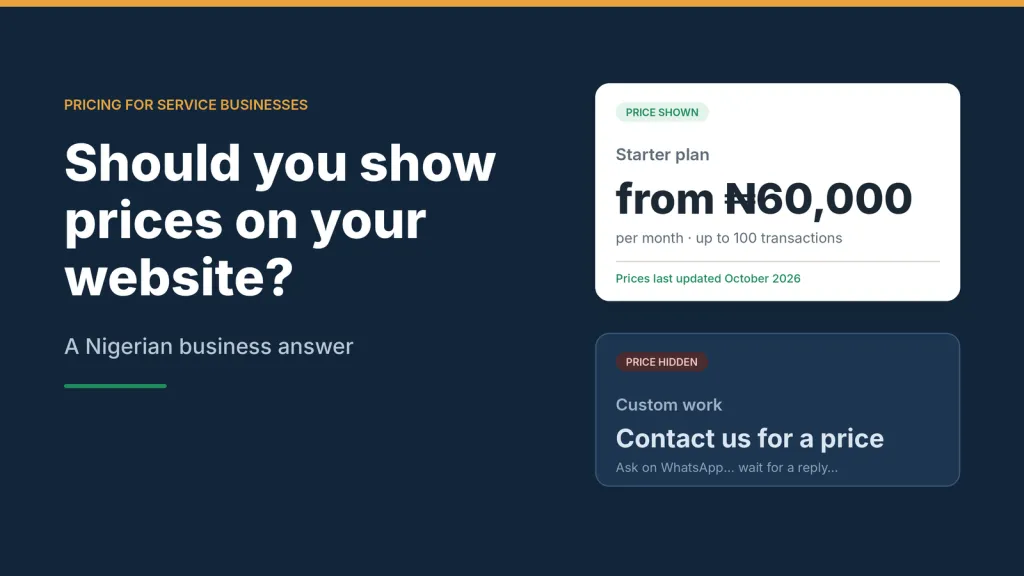


Should I display prices on my website? If you run a service business in Nigeria, the short answer is yes, or at least show a starting price. Hiding your prices does not stop customers from asking about them. It only moves the question to your DM, where you spend time on enquiries that go nowhere. This article explains when to show a price, how to do it well, and what you risk by keeping it hidden.
What hiding prices costs you in wasted enquiries
Hiding your price does not remove the price conversation. It moves it to WhatsApp, a phone call or an Instagram DM, where it costs you more.
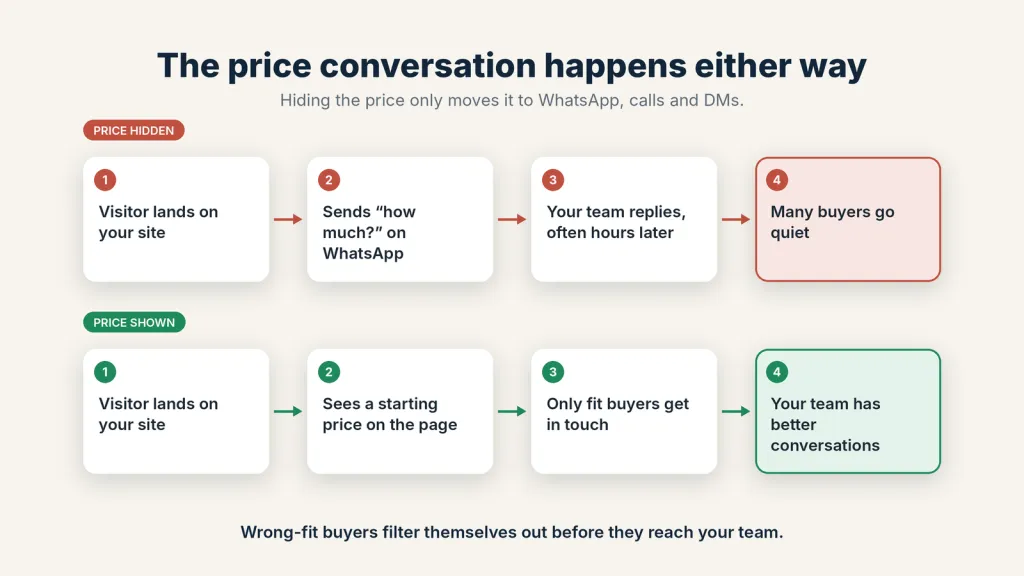
Every "how much?" message needs a person to answer it. Many of those people leave once they hear the number, so your team spends its day on enquiries that were never going to close. Others expected something far smaller or far bigger than you offer, and the mismatch only shows up after a long exchange.
Slow replies add to the cost. A buyer comparing three providers will favour the one that answered the question on the page, not the one that answered it tomorrow. There is a trust cost too: with no price in sight, many buyers assume it is high, or that it will change once you know how keen they are.
A quick test: pull your last 20 enquiries and mark how many ended right after you shared a price. If it is more than a handful, your website is doing less work than it should. Showing price lets wrong-fit buyers filter themselves out before they reach your team.
So, should I display prices on my website? For most service businesses, yes, at least a starting point.
When “from ₦X” is enough
A "from" price works when your scope varies a lot but you have a real starting point. It tells buyers the floor, which is the number they most need to decide whether to enquire.
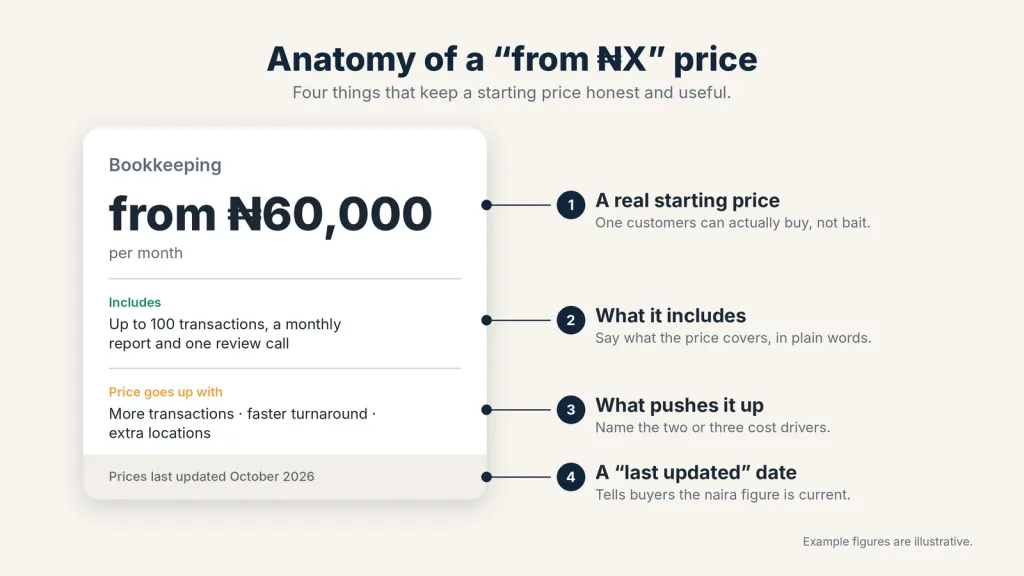
Three rules keep it honest:
- The starting price must be one customers can actually buy. If nobody ever pays it, it reads as bait, and buyers sense that quickly.
- Say what the starting price includes, for example "from ₦60,000 a month for up to 100 transactions" (an illustration, not a recommendation).
- Name the two or three things that push the price up, such as volume, speed or number of locations.
Choose "from ₦X" when jobs differ in size but follow a similar process. Move to a package or a range when the work is repeatable enough to define. Keep "by quote" for projects that are truly custom, and explain why, which the next section covers. Put the price on each service page, next to what the service includes.
Naira prices can shift with costs, so add a line such as "Prices last updated October 2026". Buyers then know the figure is current.
Price ranges, packages and “by quote” done well
Should I display prices on my website as a range, as packages or by quote? Each format suits a different kind of work.
| Format | Best when | Watch out for |
|---|---|---|
| Price range | Scope varies but outcomes are similar | A range so wide it says nothing |
| Packages | Services repeat and clients ask for the same things | Too many tiers; three is usually enough |
| By quote | Work is custom or priced on many variables | Silence, with no guide to cost |
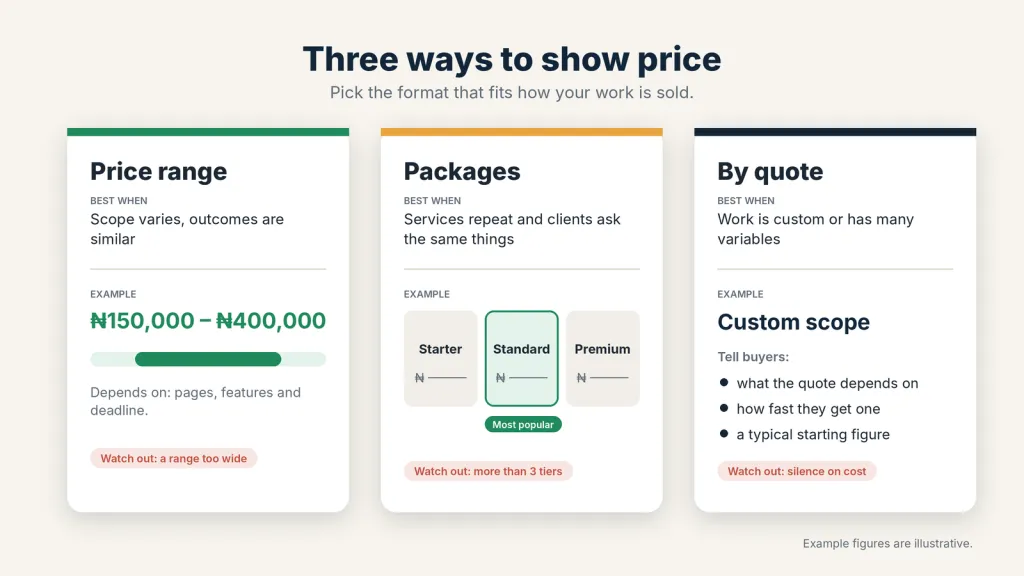
Packages work well because they answer "what do I get?" along with "what does it cost?". Name each package for the buyer's situation, list what is included in plain words, and mark the one most clients choose.
"By quote" is fine on its own terms. It becomes a problem when it is the only thing on the page. If you must quote, tell buyers what a quote depends on, how long it takes to receive one, and give a typical starting figure if you can.
Our pricing page shows what each of our plans includes, and custom work is priced by quote.
Handling “why is it expensive?” before it is asked
Once your answer to "should I display prices on my website?" is yes, buyers will start wondering why it costs what it does. Buyers rarely say it out loud. They just leave. So answer the question on the page, next to the price.
Start with what the price covers: the people involved, the time, the tools and any follow-up. A line like "includes two revisions and 30 days of support" does more than any claim about quality.
Next, explain your cost drivers. Nigerian buyers know that costs move with exchange rates, fuel and power. Say plainly which of your costs those affect, and why a much lower price usually means something has been cut.
Then put proof near the price: a short case study, a client result or a named testimonial. Proof makes the figure feel like an investment.
Finally, be ready for the cheaper competitor. You do not need to attack anyone. Say what you do that others skip, such as a written scope, a named contact or a refund policy, and let buyers decide.
What competitors showing prices already tell your customers
Your buyers are not looking only at your site. They compare you with other providers on Google, on Instagram and through referrals. If a competitor lists a price and you do not, the buyer has a number for them and a blank for you.
That blank gets filled with a guess, and the guess is rarely kind. Many buyers assume the provider with no price is the more expensive one, or the one most willing to haggle.
Do a 20-minute audit. List five competitors, then note whether they show prices, in what format, and what the price includes. You will see where the market sits and where you can stand out on value. You may also find that nobody in your niche publishes pricing, which leaves room for you to go first and win buyers who want clarity.
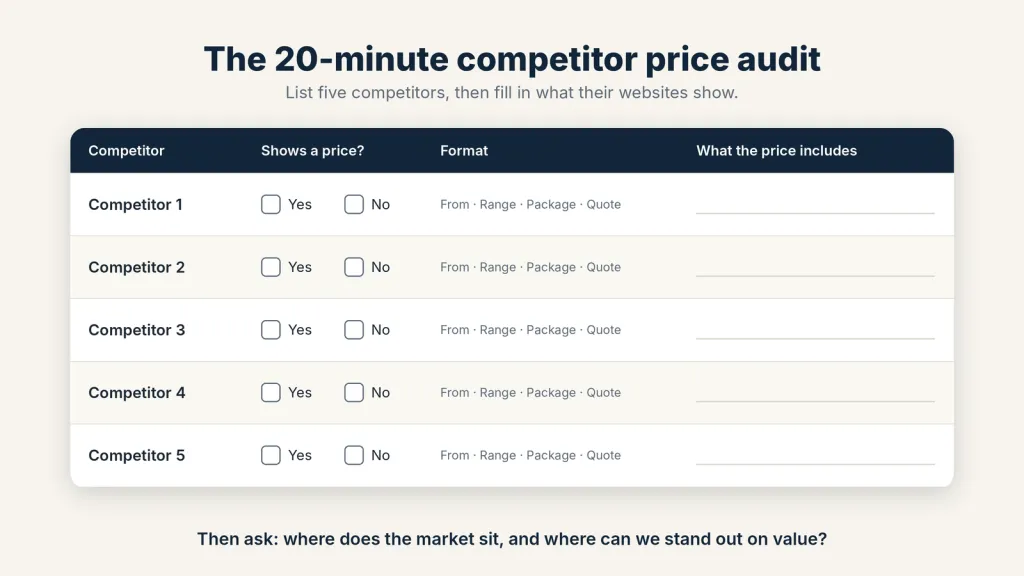
So when you ask should I display prices on my website, remember that your competitors may already be answering for you. Showing prices does not mean competing on price. It means giving buyers what they need to choose you for the right reasons.
Still asking should I display prices on my website? See what our plans include on our pricing page, or get in touch to talk through your own.
Frequently asked questions
Should I display prices on my website if my work is custom?
Yes. Show a starting point or a range, and say what drives the final quote, such as scope or speed. Buyers do not expect a fixed price for custom work, but they do expect a clue. Fully hidden pricing leaves them guessing, and many will move on to a provider who tells them.
Will competitors copy my prices?
They can already find out your price by asking a friend to enquire for them, so hiding it protects very little. Your edge is the service, the proof and the experience, and a price list does not copy those. If a competitor matches your number, you still have your track record and the way you work.
What if my costs change with the exchange rate?
Add a "last updated" date next to your prices, review them on a set schedule, and say how many days a quote stays valid. That way buyers know the figure is current, and you are not stuck with an old number. Naira prices can shift with costs, so one short line on the page protects both sides.
Will showing prices reduce enquiries?
Probably, because buyers who cannot afford you will filter themselves out. The enquiries that remain tend to be better qualified, so your team spends less time answering "how much?" and more time talking to people who are ready to buy. You may get fewer messages, but more of them should turn into customers.
Do I need to show every price?
No. Start with your most common service, watch how enquiries change, then extend the approach to the rest. Keep "by quote" for work that is truly custom, but tell buyers what the quote depends on and how long it takes to receive one, so they are not left guessing.