



There is a strange trust problem in Nigerian online shopping, and it runs in both directions.
This is where pay on delivery in Nigeria comes in.
The customer doesn't want to send money to a seller they don't trust. The seller doesn't want to send a product to a customer they don't trust. Somehow, pay on delivery became the compromise.
For the customer, it means seeing what they ordered before handing over their money. For the seller, the sale isn't really complete until the customer accepts the package. That difference matters.
Pay on delivery in Nigeria can help an online store convince a hesitant customer to place an order. But when that order is refused, the seller is left with delivery and return costs, wasted time, and a product that travelled back without earning a naira.
So, should your online store offer pay on delivery? Maybe. But not to everybody, everywhere, for everything you sell.
Why Nigerian shoppers still ask for pay on delivery
It's easy to assume a customer asking for pay on delivery simply doesn't want to pay. Usually, that isn't the case.
Someone buying from a business for the first time is taking a risk. What if the product looks nothing like the pictures? What if it never arrives? What if the seller stops replying once the money has been sent?
These fears aren't baseless. Visa's 2026 Stay Secure study found that 83% of surveyed Nigerian consumers had bought directly through social media. Yet among respondents who had experienced a financial scam in the previous year, 57% said it happened on social media.

So when a customer says, "I'll pay when it gets here," they may really be saying, "I don't know you yet." Academic research points the same way. A 2021 study by Esho and Verhoef, published in the African Journal of Business and Economic Research, found that trust and website quality were both positively linked to Nigerian consumers' purchase intentions.
That is why it can be so useful for a newer business. It gives the customer a reason to take that first chance on you.
But that convenience comes with a price.
What pay on delivery costs you when customers refuse
The trouble starts when the customer says, "I'm no longer interested."
Imagine you've just received a ₦50,000 order. You package it. You book a dispatch rider. The rider travels to the customer's address. Then the customer stops picking calls, says they've changed their mind, or suddenly doesn't have the money.
You haven't made a sale, but you've still paid to get the product there. Depending on your logistics arrangement, getting it back may cost you too.
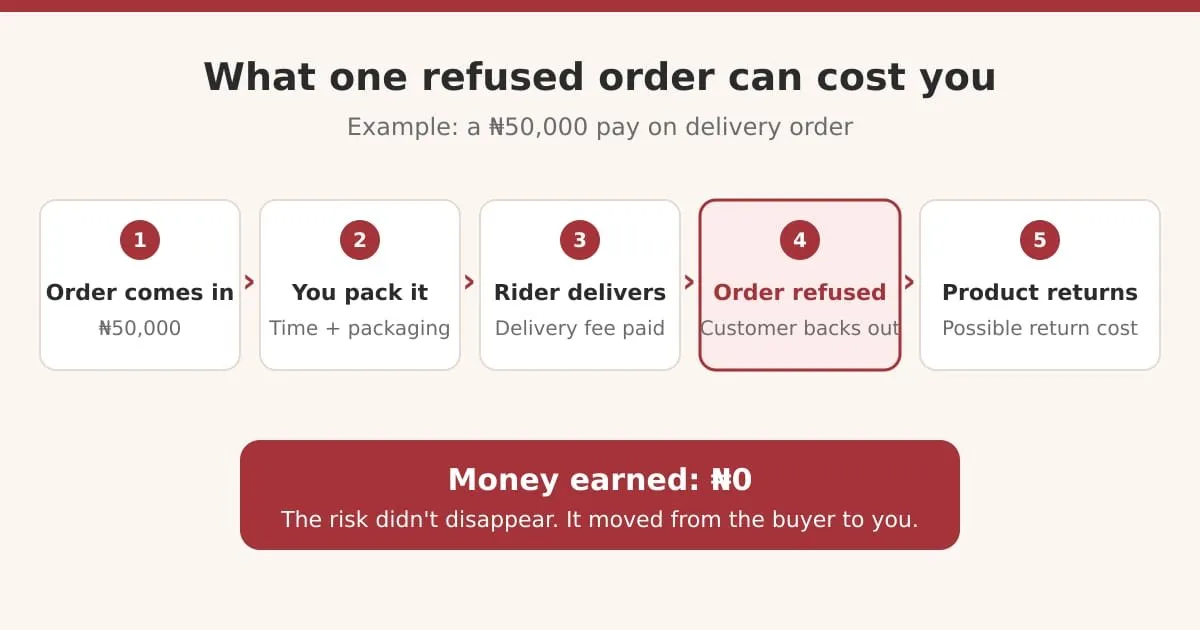
This is the biggest problem with pay on delivery in Nigeria: the risk doesn't disappear. It moves from the buyer to the seller. A 2025 study of major Nigerian e-commerce businesses found that failed cash-on-delivery orders can expose merchants to return-shipping costs, packaging and unpacking costs, logistics problems and fraudulent orders.
A large company can absorb a failed delivery. A small business selling from Instagram or WhatsApp often can't. Several refused orders in one week can eat the money that should have been your profit.
So should you scrap it altogether? Not necessarily. There is a middle ground between "pay everything before we send it" and "we'll carry all the risk."
Middle grounds that protect you without turning customers away
Ask for the delivery fee upfront. Let the customer pay for the product when it arrives, but collect the delivery fee before dispatch. If they refuse the order, you're no longer carrying the full delivery cost yourself. Just make the arrangement clear before you accept the order, so it doesn't feel like a surprise.
Consider part payment for expensive products. If someone orders a ₦100,000 customised outfit, you probably shouldn't start production without receiving anything. Agree on a deposit and collect the balance on delivery. The right amount depends on your product, your costs and your customers. There is no magic percentage that works for every business.
Match the option to the order. Some sellers offer it only for ready-to-wear items and ask for full payment on made-to-order pieces. Others allow it only for repeat customers. The point is to let your own numbers decide, not a blanket rule.

Choose which locations and products qualify
Your pay on delivery policy doesn't have to be one-size-fits-all.
Look at where your business is actually losing money. Maybe deliveries within your city are cheap and rarely refused, while orders to distant locations are expensive and riskier. You could allow it in the first case and require prepayment in the second.
The same goes for products. Low-cost, easy-to-resell items may be safe to send this way. High-value, customised or fragile items may not be. If a returned product can't easily be sold again, the risk of refusal is heavier.
Keep a simple record for a month or two: which orders were refused, from where, and for what products. Patterns show up quickly, and they'll tell you which rules to set.
Confirm every order before dispatch, politely
This one sounds obvious, but it can save you from avoidable losses. Confirming orders before dispatch is also one of the simplest ways to prevent customer complaints after the fact.
Before sending out a pay on delivery order, confirm that the customer still wants it. A short message can do the job:
"Hi, this is [Your Business]. We're confirming your order for delivery tomorrow. Will you be available to receive it? Thank you!"
If the customer says they're no longer interested, you've found out before paying a rider to make the trip.
Tone matters here. You're checking in, not interrogating. Avoid wording that sounds like you suspect the customer of playing games, such as "Are you sure you'll pay?" A friendly tone protects the relationship, and most genuine buyers will appreciate that you're organised and reliable.
Build enough trust that prepayment becomes normal
If you'd rather customers pay before delivery, the real work isn't convincing people that it is bad. It's giving them enough reason to trust you before they pay.
Put yourself in the customer's shoes and ask:
- Do your product pictures look real?
- Are your prices clear?
- Can people easily find your contact details?
- Do you show reviews from real customers?
- Is it obvious how delivery works?
- What happens if something goes wrong with the order?
Trust is built long before the payment step. You don't need a huge website or thousands of followers to start. Consistent replies, clear policies, accurate product descriptions and proof that real people have bought from you can go a long way. Research on Nigerian e-commerce keeps pointing to trust and perceived risk as major factors in whether people buy online.

As your business grows, a dedicated store also gives you more room to build that confidence: clear product pages, visible policies, secure checkout and delivery information in one place. If you're considering that step, our ecommerce development service can help you set it up properly.
The more information a customer has about your business, the less they have to guess. And less guessing means more confidence when it's time to pay.
So, should your online store offer pay on delivery in Nigeria?
Pay on delivery can help you win customers who aren't yet ready to trust your business with upfront payment. But it can also become expensive if customers regularly refuse orders.
That's why the answer shouldn't be a simple yes or no. Look at your own business:
- How much does a failed delivery cost you?
- Which products are expensive to send?
- Which locations give you the most problems?
- How often do customers refuse orders?
- How much trust have you already built?
You may decide to keep pay on delivery in Nigeria but confirm every order first. You may collect the delivery fee upfront, take deposits on expensive products, or stop offering it in certain locations. No rule says every Nigerian online store has to use the same payment system.
The goal is to make buying from you feel safe for the customer without making every sale a gamble for you.
Frequently asked questions
What is pay on delivery in Nigeria and how does it work?
Pay on delivery in Nigeria lets a customer pay for a product only when it arrives, instead of paying online first. It is a compromise Nigerian shoppers use when they are not yet sure a seller can be trusted, and it lets a hesitant customer try a new online store without upfront risk.
Why do Nigerian customers prefer pay on delivery?
Many first-time buyers worry a product will not match its pictures, will not arrive, or that a seller will stop replying once paid. Since scams on social media are common, paying on delivery lets a customer confirm an order is genuine before handing over money, which builds confidence in a new seller.
What happens if a customer refuses a pay on delivery order?
If a customer refuses a pay on delivery order, the seller has usually already paid for packaging and dispatch, and may have to cover return costs too. The risk moves from buyer to seller, and several refused orders in a short period can quickly eat into a small business's profit.
Can a seller reduce the risk of pay on delivery in Nigeria?
Yes. A seller can ask for the delivery fee upfront, request a deposit on expensive or made-to-order items, confirm each order by message before dispatch, and limit the option to certain products or locations where refusals are rare. These steps keep the offer without carrying the full cost of every refusal.
Should every online store in Nigeria offer pay on delivery?
Not necessarily. Whether pay on delivery in Nigeria suits your store depends on how often orders are refused, which products and locations cost the most when that happens, and how much trust you have already built. Many sellers keep it for some products and require prepayment for others.