

Here is how to run a win back customers campaign for buyers who stopped buying.
The customer comes, places the order—the first time, second time, maybe even third—and somehow, it stops there. Then another comes, and it just might feel like a pattern.
Let's get it: you're definitely not the only marketer. The status, the chats, the posts, the advertisements—everyone is trying to get the attention of that same customer.
Humans are like aliens and jump at whoever draws their attention. So, how can you achieve this? How do you make that customer who once purchased from you remember you, return to you, and possibly become a regular customer?
Sometimes, it isn't about getting new customers. Sometimes, it is about looking back at the customers who have already interacted with your business and finding a way to reconnect. Research published in Harvard Business Review shows that acquiring a new customer can cost five to 25 times more than keeping an existing one, which is why a win back customers campaign is worth your time

Finding the Customers Worth Winning Back
A successful order, nothing missing. You're probably wondering what happened, and somehow, you have to let go.
But what if not all customers who stopped buying are lost?
The goal here is to find who's worth winning back and who isn't. As a business owner, not all customers are the same. Not all fish in a stream are chased. There is a need to study the timing and behaviour of your customers.
Consider:
- The customer who simply purchased once.
- The one who purchases yearly, monthly, or as the case may be.
- The one who suddenly stops engaging with your posts.
- The customer who used to ask questions and make enquiries but suddenly became silent.
- The customer who was once a regular buyer but has not returned for a while.
These customers don't necessarily require the same approach.

For instance, someone who purchases from you once may have simply needed that product at that particular time. But a customer who purchased from you every month and suddenly stopped may be worth paying more attention to.
This is where knowing your customers becomes important. You can't win back what you don't understand.
No customer wants to feel too bugged or pressured. In the same way, they don't want to feel forgotten.
Why Did They Stop Buying?
Before trying to win a customer back, you need to consider why they may have stopped buying in the first place.
Was the product no longer needed? Did they find another business? Was the price an issue? Was there a problem with delivery? Did they have a bad customer-service experience?
Or, perhaps, there was absolutely nothing wrong. Maybe it was simply a one-time purchase.
This is why assumptions can be dangerous. A business owner may think, “This customer doesn't want my business anymore,” when the actual reason could be completely different.
Sometimes, all the customer needs is a reminder that you are still available.
Use the Three-Message Approach
It doesn't have to be so complicated. There's an approach to it: the gentle reminder, asking why, and the offer.
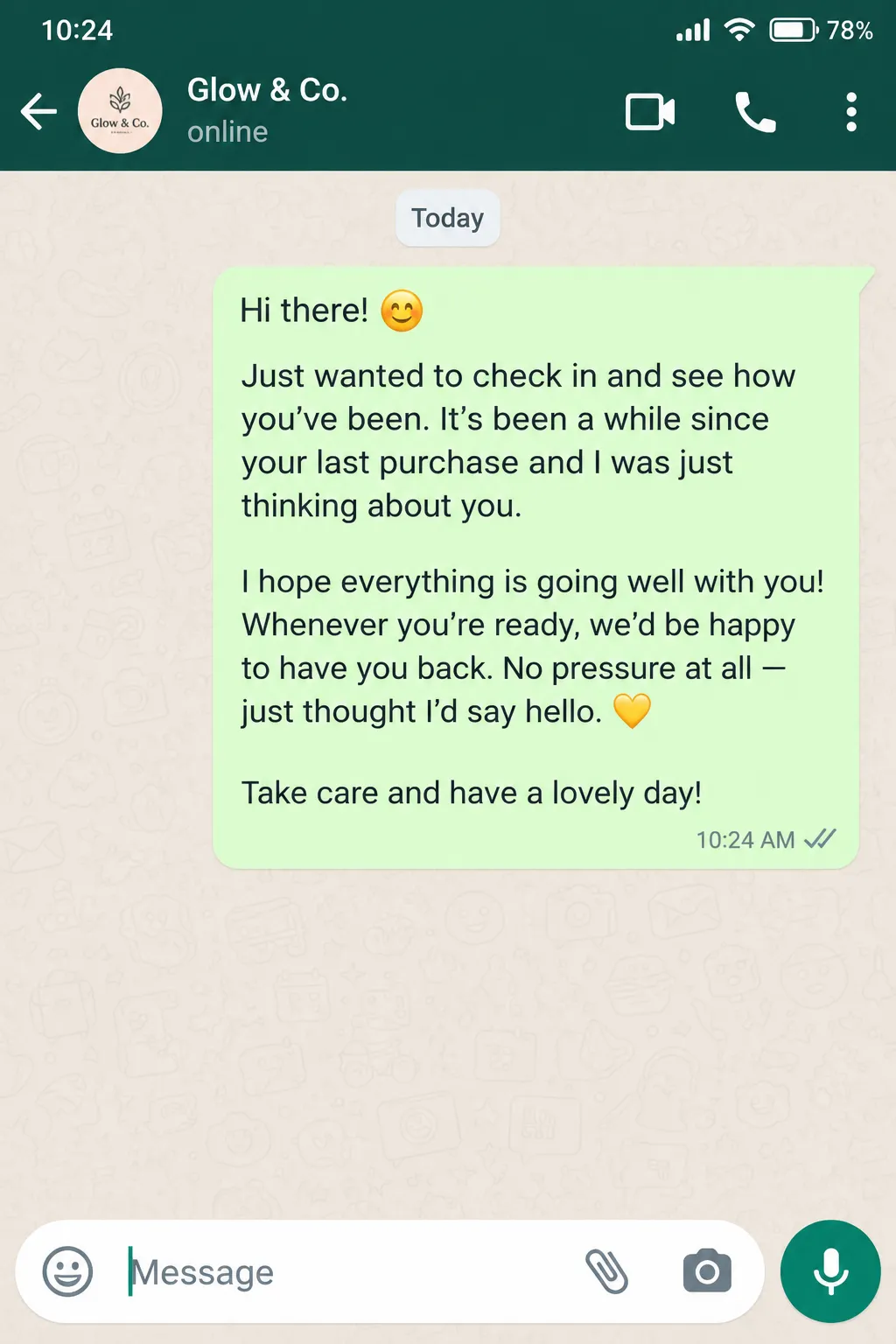
The Gentle Reminder:
This shows that, as a business owner, you value the customer. You don't just want them for their money; you value them beyond the services. You care.
Now, you're reminding the customer that, beyond the numerous marketers out there, you are still here and ready to deliver.
Something as simple as:
“Hi, it's been a while. We hope you're doing well. We noticed we haven't heard from you recently and just wanted to check in.”
can open the door without making the customer feel pressured.
Asking Why:
Now, you are not just showing off the business to the customer; you want to know what happened.
Could it be a problem from your side? Maybe it was a bad experience for the customer. Could it be that they were confused, or they probably wanted to stop doing business with you? Or was it simply a one-time order?
Give the customer room to speak.
Sometimes, the complaint you receive may be uncomfortable, but it can also show you what needs to be fixed.
The Offer:
As a business owner, you lose some and gain some. There are numerous marketers and business owners in the same sphere, probably dragging that same customer.
What could be your edge?
It could be free delivery, an extra package, a love package for that season, or something else that gives the customer a reason to return.
At this point, you're offering not just better services but new developments and offers that the customer may want to try out.
However, the offer should make sense. You don't want to throw discounts at every customer simply because they stopped buying. Sometimes, what the customer needs isn't a discount but better service, a new product or simply a reason to trust the business again.
Don't Wait Forever to Reconnect
Timing matters. Why wait forever, or possibly until you feel business is getting bad, before you reach out?
Imagine having details of customers like their birthday or wedding anniversary. Just times that create a special moment for the customer. Those moments that mean a lot.
A 30-, 60-, or probably 90-day interval could work too.
- In 30 days: You do a normal check-up. One where you're not concerned about business but about the welfare of the customer.
- In 60 days: You are asking why they haven't reached out.
- In 90 days: Now, you want to present a mouth-watering offer, something they'll definitely want to jump at.

The point is not to create a rigid formula that every business must follow. It is about understanding how frequently your customers normally purchase and using that pattern to know when something has changed.
WhatsApp, Email, Phone Call
All customers are unique, hence each has a peculiar means of reaching out.
Not all customers are open to a phone call. Some communicate via email, and others through WhatsApp. This requires every business owner to study the peculiarity of each customer and know how to reach out.
Remember, the goal isn't just to reach out but to communicate. Communication isn't just a one-man thing; there is a need to receive, and if an information isn't received, then no communication has taken place.
Also, some customers have developed more of a cordial relationship with you and hence deserve a call to reach out, check up, and know their welfare all round.
A message to a customer who prefers WhatsApp should not necessarily sound like an email. The way you communicate should match the relationship and the platform.
Using Win-Back Email Campaigns
Win-back email campaigns in Nigeria can be a simple way to reconnect with customers who have gone quiet. Instead of sending the same message to everyone, you can create emails based on how long it has been since their last purchase. A gentle reminder can come first, followed by a relevant offer or a simple question asking why they stopped buying. The goal isn't to flood their inbox but to send the right message at the right time and give them a reason to return.
Make Them Feel Remembered, Not Targeted
There is a difference between reaching out because you genuinely remember a customer and reaching out simply because you want another sale. Customers can often tell the difference.
If every message begins and ends with “Buy now,” it can quickly feel like pressure. But when you remember their previous purchase, ask how they are doing, introduce something relevant or even acknowledge a previous complaint, the interaction becomes more personal.
The goal is not to make the customer feel like another number in your customer list.
Make them feel remembered.
Measuring It Honestly
This is where you tell yourself the truth. Where you measure the process so far.
In this process, you've reached out, asked questions, provided mouth-watering offers, and done all of it.
It shouldn't feel desperate, and when it begins to feel like it, it's a sign that, with that customer, it may be a closed deal.
Also, when reaching out and complaints are received, there's a need to go back, redraft, work on it, and build the confidence for the customer to reach out again.
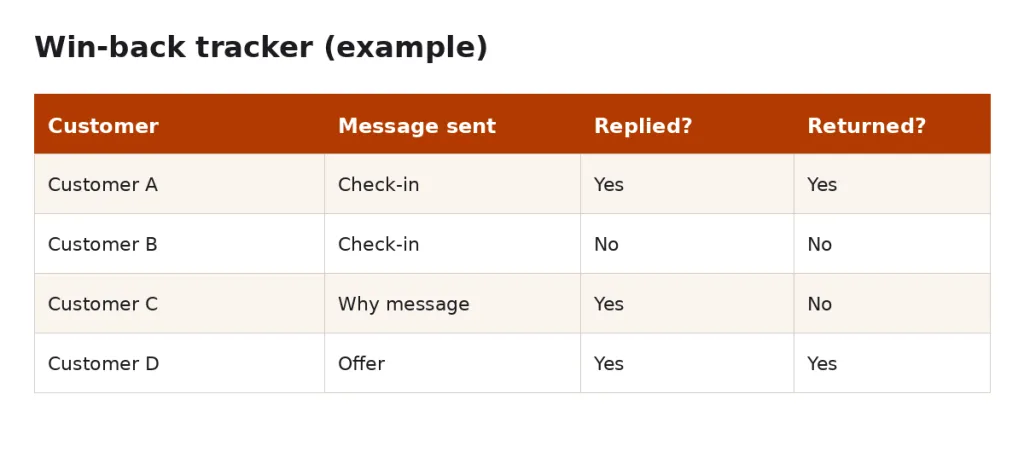
Look at the numbers too. How many customers responded? How many returned? Which message worked? Which offer attracted a response? Which customers simply didn't respond?
These details can help you understand what works for your business and what doesn't.
And sometimes, measuring honestly means accepting that not every customer will come back.
Conclusion
In conclusion, you're not just fighting for the numbers but building a relationship.
It's about checking the revenue and the value each customer holds, understanding their needs, knowing when to reach out, and knowing when to let go.
Winning back customers isn't just about making another sale. It is about reconnecting with someone who has already chosen your business before and giving them a reason to consider choosing you again.
Because sometimes, the customer you thought you had lost isn't really gone.
They may just need a reason to remember you.
Frequently asked questions
What is a win back customers campaign?
A win back customers campaign is a set of messages sent to people who bought from you before and stopped. It usually follows three steps: a gentle reminder, a question about why they left, and an offer. The aim is to rebuild trust, not to push a quick sale.
Who should I include in a win back customers campaign?
Start with customers who used to buy regularly and have gone quiet. A win back customers campaign can also include one-time buyers, but someone who bought once may only have needed that product at the time. A monthly buyer who stopped is worth far more attention.
When should a win back customers campaign start?
Start your win back customers campaign before business begins to suffer. Send a friendly check-in after about 30 days, ask why they stopped at 60 days, and make your offer at around 90 days. Treat this as a guide, because the right timing depends on how often your customers normally buy.
Should every win back customers campaign include a discount?
No. A discount is not always what brings a customer back to your win back customers campaign. Some customers need better service, a new product or a reason to trust the business again. Match the offer to the reason they left, such as free delivery or an extra package.
Should I run my win back customers campaign on WhatsApp, email or phone?
Use the channel each customer prefers for your win back customers campaign, because not everyone likes a phone call. Some reply best on WhatsApp and others on email, while a customer you know well may appreciate a call. Match your tone to the platform, so a WhatsApp message should not read like an email.
How do I know if my win back customers campaign is working?
Count how many customers replied to your win back customers campaign and how many actually returned, then note which message and which offer got a response. If reaching out to one customer starts to feel desperate, it may be time to let go of that customer.